Terminology

Learn How to Play
Pickleball & Wiffle® Ball

Before you hit the court or field, make sure you’ve got the rules down pat. To sharpen your skills and avoid getting totally pickled, we’ve broken it all down so you can spend less time scratching your head and more time making epic dinks and aces. Study up, then get out there and play like you mean it.

Yellow pickleball paddle with orange pickleball

Official Pickleball Rules

01
Serving

When the score of the serving team is an even number, the first server for that team will be on the right-side court, and when the team’s score is an odd number, the first server will be on the left-side court. The first serve for each team is made from the right-side court, and each server is allowed only one attempt to serve.

The server must have one foot behind the baseline at the time of striking the ball. The paddle cannot make contact with the ball above waist level and the server must be moving their arm in an upward motion when contact is made with the ball — unless the server is making a drop serve, where the server drops the ball and hits it underhand after the ball bounces on the ground.

The serve must go diagonally across the court and land in bounds in the opposite diagonal court.

In doubles, both players can serve and score points until they commit a fault. When a point is scored by the serving team, the server switches sides of the court and serves from the new side. This switching continues until a fault is committed and the serve is lost.

When the first server loses the serve, their partner serves and continues serving until a fault is committed. The serve then goes to the opposing team.

At the beginning of a game, only the first server on the first serving team can serve until a fault; then the serve goes to the opposing team. Any method can be used to decide which team should serve first (coin toss, etc).

02
Two-Bounce Rule

The team receiving the serve must let the ball bounce before returning it, and then the serving team must let the ball bounce once before returning it. After the two bounces, the players may volley (hit the ball before it bounces) or hit the ball after letting it bounce once.

03
Non-Volley Zone

The non-volley zone, referred to as the kitchen, is the area of the court within 7 feet of both sides of the net. Players cannot hit the ball within the kitchen without letting it first bounce. If a player steps into the kitchen when volleying the ball, that is a fault. It is also a fault if the volleying player enters the kitchen after volleying the ball. A player may be in the kitchen legally if not volleying the ball.

04
Line Calls

Balls hitting any of the court boundary lines, excluding the non-volley line during a serve, are considered in bounds. If a serve hits the non-volley line, that is considered short and is a fault.

05
Faults

Faults are rule violations that stop play. When the serving team faults, the server loses the serve. When the receiving team faults, the serving team scores a point. Faults include:

  • A player, their clothing, or paddle touches the net or net post during play.
  • A ball in play strikes a player or their clothing.
  • A ball in play strikes an object (e.g., net post) before bouncing.
  • A ball bounces twice before being hit.
  • A ball is volleyed before bouncing once on each side of the court (two-bounce rule).
  • A serve does not land in bounds on the opposite side of the court.
  • The ball is hit into the net.
  • The ball is hit out of bounds.
  • A ball is volleyed from the kitchen (non-volley zone).
  • Serving rules are violated.

06
Scoring

Pickleball games are typically played to 11 points and must be won by 2 points. Tournament games may be played to 15 or 21 points. There are two scoring systems: traditional side-out scoring and rally scoring. In side-out scoring, only the serving team scores points. In rally scoring, a point is scored after every rally.

Um, what is a dink?
Pickleball Glossary

AceA serve that lands in bounds in the opponent’s court that goes untouched by the opponent.
AlleyThe area between the sideline used in singles pickleball and the sideline used in doubles play.
BaselineThe boundary line at the back of the court, where players stand to serve.
BertLike an ERNE but on your teammates' side of the court. Think of it as a surprise poach shot by your partner in front of you.
CarryA hit where the ball remains on the paddle for an extended period of time.
DinkA soft hit that goes just over the next and lands in our near the opponent’s kitchen, forcing them to let the ball bounce before returning it.
DriveA hard hit shot with speed and power.
Drop ServeA legal serve made by dropping the ball and hitting it underhand after it bounces.
Drop ShotA shot hit from deep in the court that lands just over the net and in or near the opponent’s kitchen, similar to a dink.
DeuceA tied score of 10 to 10, which requires one team to win by two points in order to win the game.
ErneA shot taken by a player who is outside of the court, in the out-of-bounds area to the left or right of the sideline.
FaultAn error resulting in the loss of a point.
Foot FaultAn error resulting in the loss of a point resulting from a player stepping into the kitchen during play.
Golden PickleWhen the winning team Pickles the losing team (they don't ever score) with the same server - i.e. the first person who served never stopped serving until the game was over.
KitchenThe non-volley zone of the court, immediately in front of the net on each side of the court. Players cannot legally volley the ball standing in this area.
Let ServeA legal serve that touches the net and lands in the opponent’s court.
Match PointThe final point in the game; when one player or team needs only one more point to win.
Nasty NelsonNamed after Tim Nelson, "the Puppet Master.” When the server serves directly to the opposing team member and hits them before they can get out of the way, resulting in a point for the server.
Rule 4N2: If the receiver or their partner interferes or touches the ball before it bounces, it's considered a fault.
PoachWhen a player in a double’s match hits a ball on their partner’s side of the court.
PickledLosing a game without scoring any points.
RallyA series of back-and-forth shots between players that continues until an error or fault.
Side-outWhen the serving team loses the point and the serve goes to the opposing team.
SkunkedLosing a game without scoring any points.
VolleyHitting the ball before it bounces.
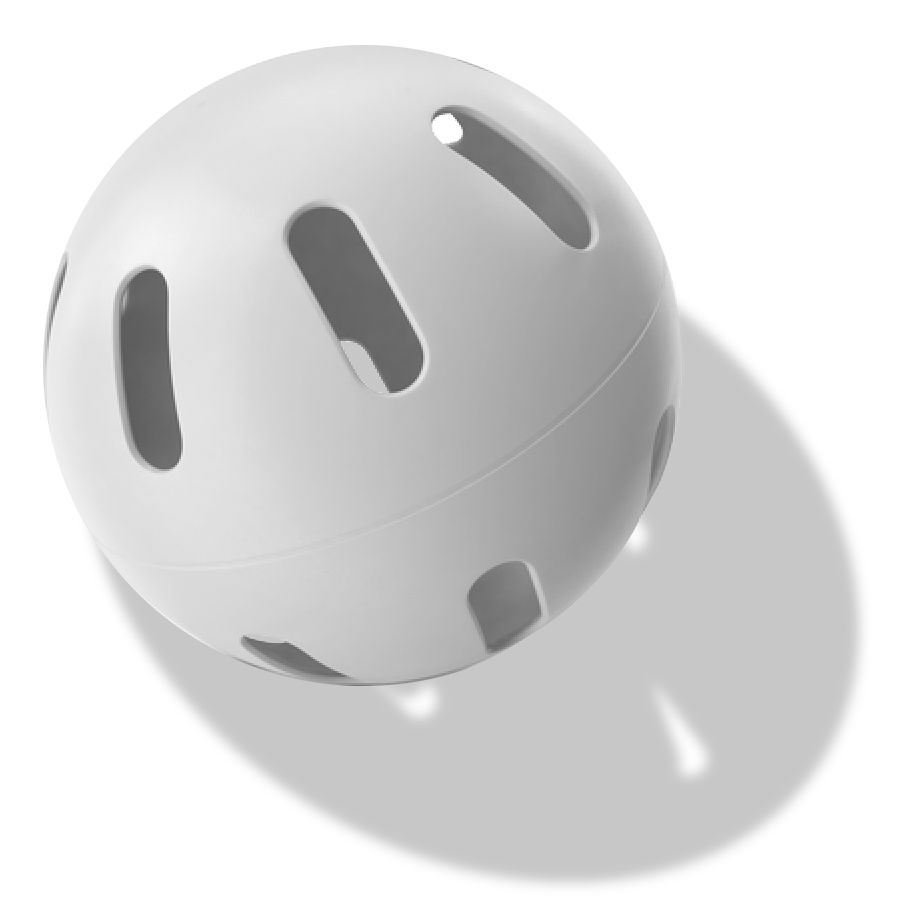
White Wiffle Ball with a shadow

Wiffle® Ball Official Rules

01
Basic Structure

Wiffle® Ball is played with two teams of up to five players. Games last for six innings; an inning is a two-part round of play. In an inning, one team will play offense (batting) and the other, defense (pitching and fielding). After the defensive team makes three outs against the offensive team, the teams will switch roles.

02
Pitching

One defensive player is the pitcher, who throws the ball over home plate for the batter to hit. The pitcher must throw the ball within the strike zone — the area over the plate from the batter’s elbows to their knees where the batter can be reasonably expected to hit the ball. Pitches thrown within this zone are strikes and are counted against the batter if not hit. Pitches outside of the strike zone are considered balls, and are counted against the pitcher.

A pitcher can get a batter out by getting three strikes against the batter. When a ball is hit, the pitcher can also field the ball and make plays to get runners out.

03
Fielding

The other defensive players are fielders. They catch and retrieve the ball when it has been hit by the batter. Fielders can make outs by catching fly balls — hits that are in the air and have not touched the ground or by fielding ground balls and tagging the base a runner is advancing to or throwing the ball to another player who then tags the base.

04
Hitting

The team at bat sends up one player at a time to bat. This player stands in the batter’s box alongside home plate and uses a plastic Wiffle® Ball bat to hit the ball the pitcher throws to them. Batters may choose not to swing at any pitch. When a batter hits a ball that is outside of bounds along the foul lines, that is a foul ball and counts as a strike unless the batter already has two strikes. If a fielder catches a foul ball in the air, the batter is out.

05
Running

There are no live runners in Wiffle® Ball. Instead, ghost (imaginary) runners advance around the bases, depending on the zone in which the batter hits the ball. Balls hit into the first zone are singles (runner advances from home to first base), the second zone are doubles (batter advances from home to second base), and the third zone are triples (runner advances from home to third base). Balls hit beyond the end line are home runs, advancing the runner from home through the bases back to home plate. Any runners already on base advance the same number of spaces as the hit (e.g., a runner already on second base when a single is hit will advance to third base).

06
Scoring

The team at-bat scores points when runners cross home plate. At the end of six innings, the team with the highest score wins. If there is a tie, the game may go into extra innings until, at the end of an inning, a team wins.

So what's a dinger anyway?
Wiffle® Ball Glossary

Ball(In pitching/batting) A pitch that is not within the strike zone.
BuntA type of hit where the batter lightly taps the ball instead of fully swinging.
Choke UpTo move one’s hands up higher on the bat.
CurveballA pitch that curves unexpectedly when crossing the plate.
DingerA home run.
Double PlayWhen the fielding team gets two outs on the same play.
Fielder's ChoiceWhen the fielder fielding the ball can choose whether to get the batter or another runner out during a play.
Fly BallA ball hit into the air and caught in the air.
Foul BallA ball hit by the batter that is outside of the foul lines and is not in bounds.
Full CountWhen the batter has three balls and two strikes.
GrounderWhen the ball is hit and rolls on the ground.
KnuckleballA pitch where the pitcher grips the ball with their knuckles instead of their fingers.
SinkerA pitch that drops unexpectedly, with the goal of misleading the batter and causing them to strike.
StrikeWhen a batter either swings and misses a pitch or does not swing on a pitch that is in the strike zone.
Strike ZoneThe area in which the pitches must cross the plate in order to be considered strikes. This zone is generally between the batter’s elbows and kneecaps.
RiserA pitch that rises unexpectedly when crossing the plate.
WalkWhen a batter is pitched 4 balls and is advanced automatically to first base.
Dinks and Dingers logo
Privacy Overview

This website uses cookies so that we can provide you with the best user experience possible. Cookie information is stored in your browser and performs functions such as recognising you when you return to our website and helping our team to understand which sections of the website you find most interesting and useful.